
The Mall is a Zombie: Report from the Field
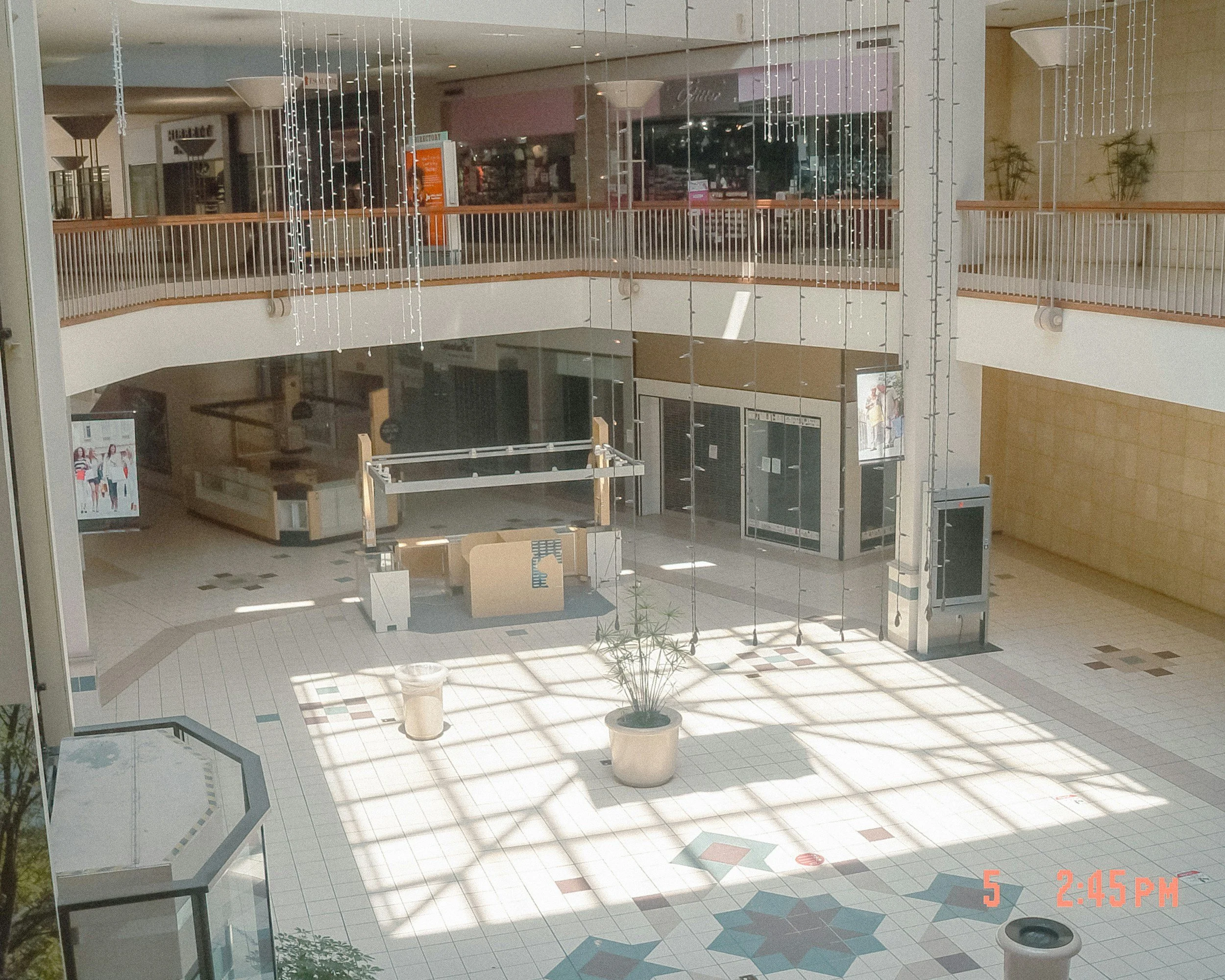
Photo by Hunter Newton on Unsplash
Recently, only our neighborhood in our little city lost power, an errant downed branch. The temperature has been ten to fifteen degrees Fahrenheit over the average, and I wonder when we will update these averages. Two years ago this month, my city was devastated by Hurricane Helene, an anomaly that will soon become horrifyingly commonplace. For air conditioning, we decamped to the mall for a hazy afternoon.
Like most malls, the Asheville Mall is perpetually dying, a commercial center on unending hospice – although the local art scene has repurposed one hallway. I was too young for malls’ heyday, and too rural, anyway. Although I now commute an hour each way, my family was one that treated the forty-minute drive to the nearest mall as a bridge too far for anything but an occasional treat, and the one an hour away as a seasonal excursion at best. I never once roamed the mall with a pack of teenaged friends, never once said I was going somewhere and went to the mall instead.
The mall of my dreams is mostly written by my dear friend Stacy Jane Grover. In my mind, she is perpetually managing a Hot Topic in the perfect mall, and I am drinking a smoothie and shopping at Abercrombie & Fitch again, my under-formed body pressing against laughably distressed jeans. In the mall of my heart, there are escalators, a Sbarro, a CD store where we buy the latest 3OH!3 album. What I’m saying is, I did not go to the mall in the same way as my elder Millennial or younger Gen X friends and peers did. I have only the dream of the mall.
And the mall, even when subverted, is a building for selling and buying, a capitalist rollercoaster of liminal space meant to make the space between you and your money fit your insecurities. There are heavy bags at the mall, which feel like tasks being done. There are smells and textures, lights and heavy music. There is food at the mall, and a cold Diet Mountain Dew, and every dressing room is a portal to the better version of yourself, the one that looks cool, maybe, or interesting. That version of you is about seventy dollars away at the mall, and you can always get there.
Or, you could. That mall does not exist.
I will not be recounting the endless death of the mall. Instead, this report from the field is about the mall of today, which has been reanimated, like a zombie, into the internet. Or more accurately, AI slop from the internet. The mall is where you can step through your phone screen and touch whatever you thought you wanted to touch online.
Fill in this blank: “the viral ______.” You can buy that at the mall now.
Dubai chocolate, puking green bile out of broken chocolate bars on posters at a candy shop. A large squishy fidget that says BUTTER. T-shirts that look AI generated for your great-aunt’s individualized Facebook ads on oddly proportioned mannequins. Kiosks stuffed with plastic trinkets, with Labubus, with phone charms, with sunglasses with tiny rhinestones. There’s an entire knockoff toy store with, if you only glance quickly, convincingly knocked off Disney plushies. Advertisements have the, at the time of this posting, telltale flick marks of AI creation, because AI has never seen a space that should not be filled with some errant mark, punctuation, color gradient, swirl, or image. AI’s job is to create, and it does, infinitely, making disgusting and odd choices along the way.
The mall used to be empty, dying. Now, thanks to AI and dropshipping schemes, it has been reanimated, like a corpse wriggling with digestive insects. The mall is filled with nothing now, and I want to be, too, some beautiful nothingness.
When I scroll on Instagram, ten-slide posts regurgitate AI talking points: Not this. Not this. Not this. Only this, quietly. On Facebook, friends share 800-word posts about historical figures written in breathless prose, all designed for sharing. I recently called AI use and writing pureed, or Fisher Price, but that is denigrating both pureed foods and Fisher Price. We feed babies purees because they do not have teeth (and do not speak to me about baby led weaning, I beg, a rant for another day). We give babies three-hole shape sorters because they are just learning that things like shapes, colors, and their own hands exist. In short, we create the simplest possible things for people for whom that simplicity is physically or developmentally required.
And if you are reading this piece – which I have typed, by hand, into a word processor, without the use of AI beyond spellcheck – then you do not need AI.
You do not need a squishy toy that releases carcinogens into the air that you breathe in, smearing it on your skin. You do not need a few hundred plastic gems for an Instagram image. You do not need a Labubu. I have plenty of things I don’t need, too, don’t get me wrong; unfortunately, I am still eating red meat, still drinking coffee, still buying my toddler clothes from Walmart for his mud kitchen adventures. I am not above the convenience and excesses of our American life.
What I am above is the junk of the mall, and how stupid it thinks I am. I did not see anyone purchasing those knockoff plushies, those fidgets, those phone charms. Workers sat scrolling on their phones at the kiosks, not even trying to make a sale. We are living in the slop world, and we all hate it. There is no such thing as opting out. We can only move forward together.
You can read Emily Blair’s previous work for Boshemia here: We’re Here, We’re Queer, But Can We Pee Here? and This is How Two Women Have Sex and An Academic Conference Survival Guide, From One Femme Queer to the Next.